



I approached Surveys On The Go as a small, practical way to earn from spare minutes rather than as a serious income source. That distinction matters. The app belongs to the lifestyle category, and its basic idea is simple: answer market-research surveys and receive cash instead of collecting a points balance that has to be converted later. In my experience, that makes it easier to understand what each completed task is worth, even though the number and timing of available surveys can vary.
My overall view is positive but measured. This is a useful option for people who regularly have short gaps in their day and do not mind sharing opinions through structured questionnaires. It is less suitable for anyone expecting dependable daily earnings, a constant stream of tasks, or a replacement for regular work. The strongest reason to try it is the direct cash model; the biggest reason to stay realistic is that survey availability depends heavily on whether your profile matches what researchers currently need.
How the app feels in everyday use
The experience is built around checking in when you have time, looking at the surveys offered, and deciding whether the expected reward justifies the effort. I like that this encourages a quick, low-commitment routine. I can imagine opening it while waiting for an appointment, sitting on public transport, or taking a break between errands rather than planning an entire evening around it.
A realistic use case is a commuter who has several short waits during the week. Instead of opening a game or scrolling through social media, that person can check whether a relevant questionnaire is available, read the screening questions carefully, and complete it if the time requirement feels reasonable. The value comes from combining many small opportunities, not from treating one survey as a financial event.
The app is free, which removes the main barrier to testing it. It is also rated for Everyone, so its presentation is approachable rather than aimed at a narrow specialist audience. I would still encourage users to read each survey screen attentively. A questionnaire is not worth rushing through, especially when inconsistent answers can make the experience frustrating or reduce the usefulness of the research.
The app comes from MFour Data Research, Inc., a developer associated with this kind of mobile research experience. Its long presence is reflected in a release date of October 12, 2011, while the current version is 3.6.0 and requires Android 8.0 or later. That combination tells me it is not a brand-new experiment, but Android users should still check their operating-system version before spending time setting it up.
The direct-cash approach is the clearest advantage
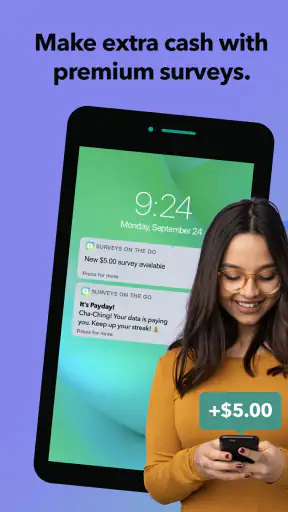
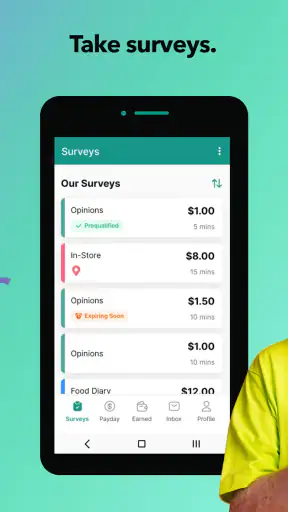
Many survey apps make the reward feel distant by using points, badges, or several redemption steps. Here, the central promise is easier to grasp: individual surveys can pay roughly one to five dollars, and the service emphasizes fast cash-out. I find that more transparent than watching an abstract points total grow and then trying to calculate its real value.
That does not mean every session will produce a payment. The practical benefit is that, when a survey is available and I qualify, I can judge it using a familiar currency. This is particularly helpful for deciding whether a longer questionnaire is worth completing. A direct reward also makes it easier to keep expectations under control: a few dollars is useful pocket money, but it is not a wage.
The app’s popularity supports the idea that this format appeals to a broad audience. It has passed five million installs, with an average rating of 4.4 from around 131 thousand ratings and about 68 thousand written reviews. I would not treat those figures as a guarantee of my own experience, because survey supply and qualification can differ from person to person, but they do suggest that the concept has found a substantial user base.
What I would do before starting a survey
My first tip is to avoid beginning a questionnaire automatically just because it appears. I would look at the reward, estimate how much uninterrupted time I have, and make sure I am somewhere quiet enough to answer consistently. A survey started during a noisy checkout line may become more trouble than it is worth, particularly if it contains detailed questions or screening stages.
Second, I would answer profile questions honestly and consistently. Market research depends on matching participants to a target audience, so trying to guess which answer will unlock more surveys can work against the user. A stable profile is more useful than attempting to present a different identity for every opportunity.
Third, I would treat notifications as invitations rather than obligations. If the app alerts me while I am busy, I would wait until I can concentrate. Responding quickly may be useful when an opportunity is time-sensitive, but speed should not lead to careless answers. The better workflow is to keep the app available, check it during natural breaks, and stop when the task no longer fits the moment.
A less obvious strength is psychological rather than technical: the cash-based format helps prevent me from confusing activity with value. With points, completing many small tasks can feel productive even when the eventual reward is unclear. Seeing a cash amount makes the trade-off more visible. That makes the app easier to evaluate honestly after a week or two of normal use.
Where the experience becomes less predictable
The main weakness is not complicated navigation; it is uncertainty. A survey app can be perfectly designed and still feel disappointing if there is nothing relevant available when I open it. Eligibility depends on research needs, location, demographics, and the answers given during screening. Someone may check several times and find that opportunities are limited, while another user receives more invitations.
That variability makes this a poor choice for people who need a predictable amount of money by a particular date. I would not use it to plan a bill payment, replace a scheduled shift, or promise myself a fixed weekly return. The app works better as an optional supplement for spare time than as a dependable earning system.
Screening can also create friction. A questionnaire may begin with questions designed to determine whether I fit the intended audience, and not every attempt will lead to a completed survey. Even when the process is normal for research, it can feel inefficient if I have already invested time before learning that I am not the right participant. My advice is to accept this as part of the model rather than interpreting every unsuccessful attempt as an app malfunction.
There is another trade-off between speed and attention. The store summary presents the possibility of earning one to five dollars and cashing out quickly, but the reward still has to be considered alongside the time involved. A short, well-matched survey can be worthwhile. A longer task with several screening steps may be less attractive, even if its headline payment looks better. I would compare the likely effort, not just the dollar figure.
Who will get the most from it
I think this app fits adults who enjoy giving opinions, have irregular pockets of free time, and are comfortable with earnings that fluctuate. It can suit students between classes, commuters waiting for transport, parents with occasional quiet breaks, or anyone who wants a small cash return from time that would otherwise disappear into scrolling.
It is also a reasonable starting point for someone who has never used a survey service. The free entry and straightforward cash framing make the concept easy to test without first learning a complicated rewards system. I would suggest using it for a limited trial period, tracking how often suitable surveys appear and whether the effort feels worthwhile, then deciding whether it deserves a regular place on the phone.
The best users are patient and selective. They do not assume that every notification will become a payment, and they do not force themselves through a task that feels unreasonably long. They also understand that honest answers are part of the exchange. The app is not asking users to perform a technical skill; its value comes from providing considered feedback that researchers can use.
Who should choose something else
I would skip this app if I dislike questionnaires, become annoyed by screening questions, or need guaranteed work. It is also not ideal for someone who wants a fixed routine with the same number of tasks every day. A conventional part-time job, freelance assignment, or other gig platform is a better comparison when reliability and planning matter more than convenience.
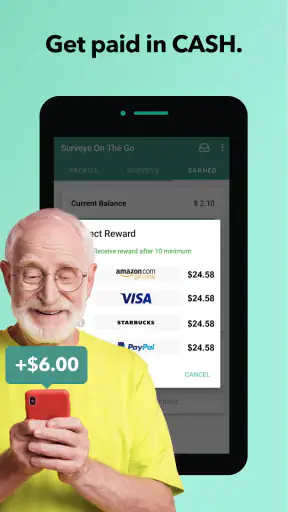
People who prefer rewards such as gift cards, discounts, or loyalty benefits may also find a different rewards app more appealing. The direct-cash approach is the reason I like this service, but it will not suit someone who values a broader catalog of redemption choices. Likewise, users who rarely have a few uninterrupted minutes may find that the app creates more unfinished attempts than useful earnings.
Compared with ordinary alternatives in the survey category, the most important difference is the way the reward is presented. A points-based service may offer more gamified progress or a wider range of redemption options, while Surveys On The Go keeps attention on cash for completed research. I prefer that clarity, but I would accept the trade-off of a less entertaining experience and potentially uneven availability.
Questions I would ask before installing
Is it genuinely free to try? Yes, the app is free, so there is no purchase required simply to begin. I would still approach every earning app with normal caution, read the screens before submitting information, and avoid assuming that free installation means guaranteed income.
How much can I realistically make? The available survey rewards are presented in the range of one to five dollars, but that should not be read as a daily promise. The realistic outcome depends on how often I qualify, how many opportunities appear, and how much time I choose to spend. I would regard any payment as supplemental pocket money.
Does a quick cash-out mean instant money after every survey? No. The useful interpretation is that the service aims to make withdrawing earnings fast, not that every completed questionnaire creates an immediate, guaranteed transfer without any process. I would check the in-app cash-out instructions carefully and confirm that my account details are entered correctly.
Will it work on an older phone? The current Android version requires Android 8.0 or later. If my device runs an earlier system, I would not rely on the app working properly and would first check whether an operating-system update is available.
Is it safe for younger users? Its content rating is Everyone, which makes the app broadly accessible in terms of store classification. Even so, I would encourage families to discuss survey participation and personal information before a child uses any research app. A general age rating does not remove the need for sensible privacy decisions.
My final recommendation
After weighing the convenience against the uncertainty, I see Surveys On The Go as a credible pocket-money tool rather than a dependable income source. Its best quality is the direct, understandable cash model: I know what the reward represents, and I can use spare minutes without paying to join. The app’s long history, current Android support, and large user community make it worth considering for people who already like answering surveys.
My reservation is equally clear. The experience depends on receiving suitable invitations and passing screening, so patience is essential. If I needed predictable earnings, I would choose another kind of work. If I wanted a playful rewards system or many redemption formats, I might prefer a points-based alternative. But if I wanted a free way to turn occasional idle time into modest cash, I would give this app a fair trial.
My recommendation is to install it with modest expectations, use it selectively, and judge it by the value of your actual time. For the right person, that makes the app a convenient extra rather than an empty promise. For everyone else, the uneven survey supply may outweigh the simplicity of cash rewards.


